
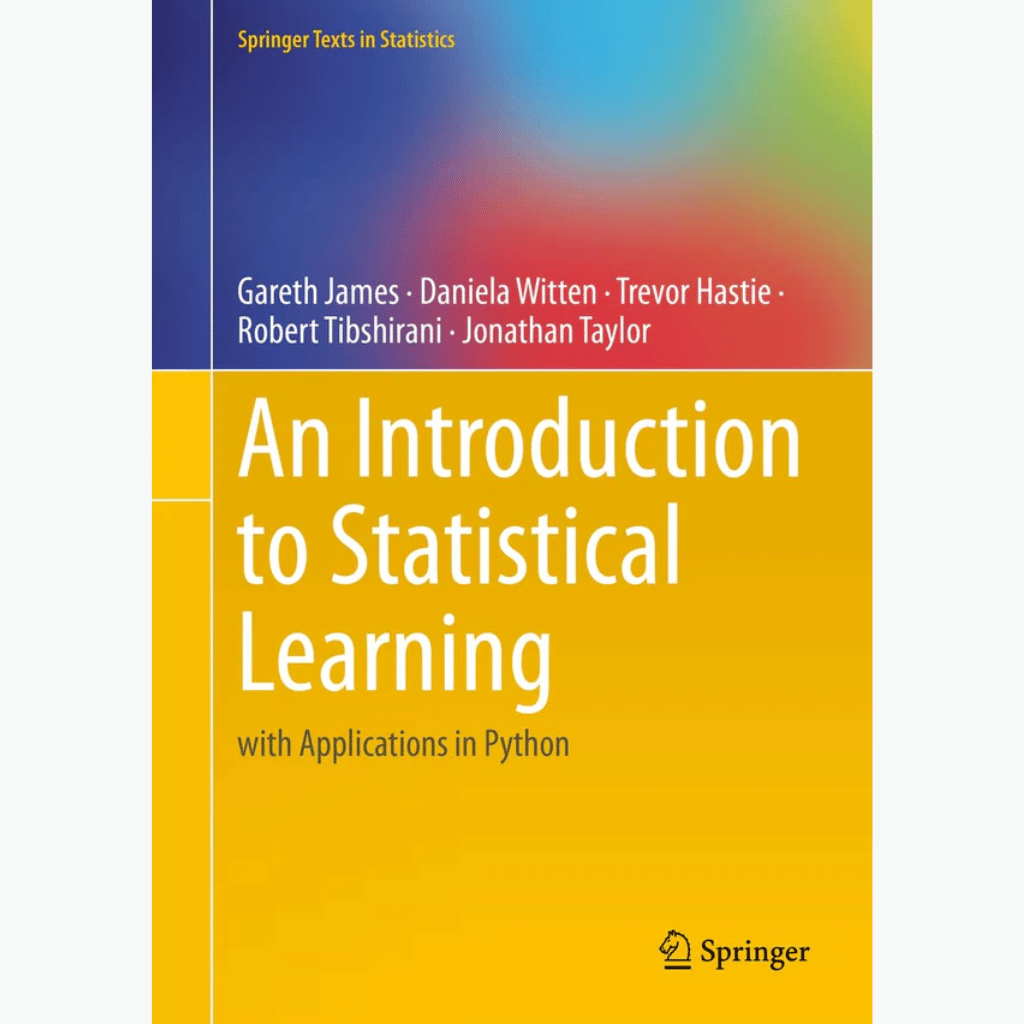


An Introduction to Statistical Learning: with Applications in R (Springer Texts in Statistics) 2nd ed ISBN: 9781071614174
Original price was: $89.99.$54.99Current price is: $54.99.
Product Details
- Condition: New
- Publisher: Springer
- Language: English
- Paperback: Hardcover
- ISBN: 978-1071614174
- Item Weight: 3.6 pounds
- Dimensions: 7.17 x 1.65 x 10.08 inches

Description
An Introduction to Statistical Learning provides an accessible overview of the field of statistical learning, an essential toolset for making sense of the vast and complex data sets that have emerged in fields ranging from biology to finance to marketing to astrophysics in the past twenty years. This book presents some of the most important modeling and prediction techniques, along with relevant applications. Topics include linear regression, classification, resampling methods, shrinkage approaches, tree-based methods, support vector machines, clustering, deep learning, survival analysis, multiple testing, and more. Color graphics and real-world examples are used to illustrate the methods presented. Since the goal of this textbook is to facilitate the use of these statistical learning techniques by practitioners in science, industry, and other fields, each chapter contains a tutorial on implementing the analyses and methods presented in R, an extremely popular open source statistical software platform.
Two of the authors co-wrote The Elements of Statistical Learning (Hastie, Tibshirani and Friedman, 2nd edition 2009), a popular reference book for statistics and machine learning researchers. An Introduction to Statistical Learning covers many of the same topics, but at a level accessible to a much broader audience. This book is targeted at statisticians and non-statisticians alike who wish to use cutting-edge statistical learning techniques to analyze their data. The text assumes only a previous course in linear regression and no knowledge of matrix algebra.
This Second Edition features new chapters on deep learning, survival analysis, and multiple testing, as well as expanded treatments of naïve Bayes, generalized linear models, Bayesian additive regression trees, and matrix completion. R code has been updated throughout to ensure compatibility.
Four of the authors co-wrote An Introduction to Statistical Learning, With Applications in R(ISLR), which has become a mainstay of undergraduate and graduate classrooms worldwide, as well as an important reference book for data scientists. One of the keys to its success was that each chapter contains a tutorial on implementing the analyses and methods presented in the R scientific computing environment. However, in recent years Python has become a popular language for data science, and there has been increasing demand for a Python-based alternative to ISLR. Hence, this book (ISLP) covers the same materials as ISLR but with labs implemented in Python. These labs will be useful both for Python novices, as well as experienced users.
Shipping, Return & Exchange
Shipping & Delivery:
– Normal Delivery: Estimated delivery time is 5 to 7 business days from the date of shipment.
– Express Delivery: Estimated delivery time is 3 to 5 business days from the date of shipment.
Returns & Exchange:
– Please refer to our Return and Exchange Policy for more details.
| Weight | 3.6 lbs |
|---|---|
| Dimensions | 18.2118 × 0.748427 × 25.6032 in |






Ethan Miller –
A very approachable introduction to statistical learning. The explanations are clear, and the R examples help connect theory with real practice.
Olivia Bennett –
Great balance between mathematics and practical application. The visuals and step-by-step examples make complex topics much easier to understand.
Noah Richardson –
One of the best beginner-friendly books on machine learning concepts. The structure and real-world examples make it enjoyable to study.
Liam Parker –
The updated edition is excellent, especially with the new topics included. Helpful for students and professionals getting into data science.
Jacob Turner –
A solid reference for learning modeling and prediction techniques. The R labs at the end of chapters are very useful for hands-on practice.